
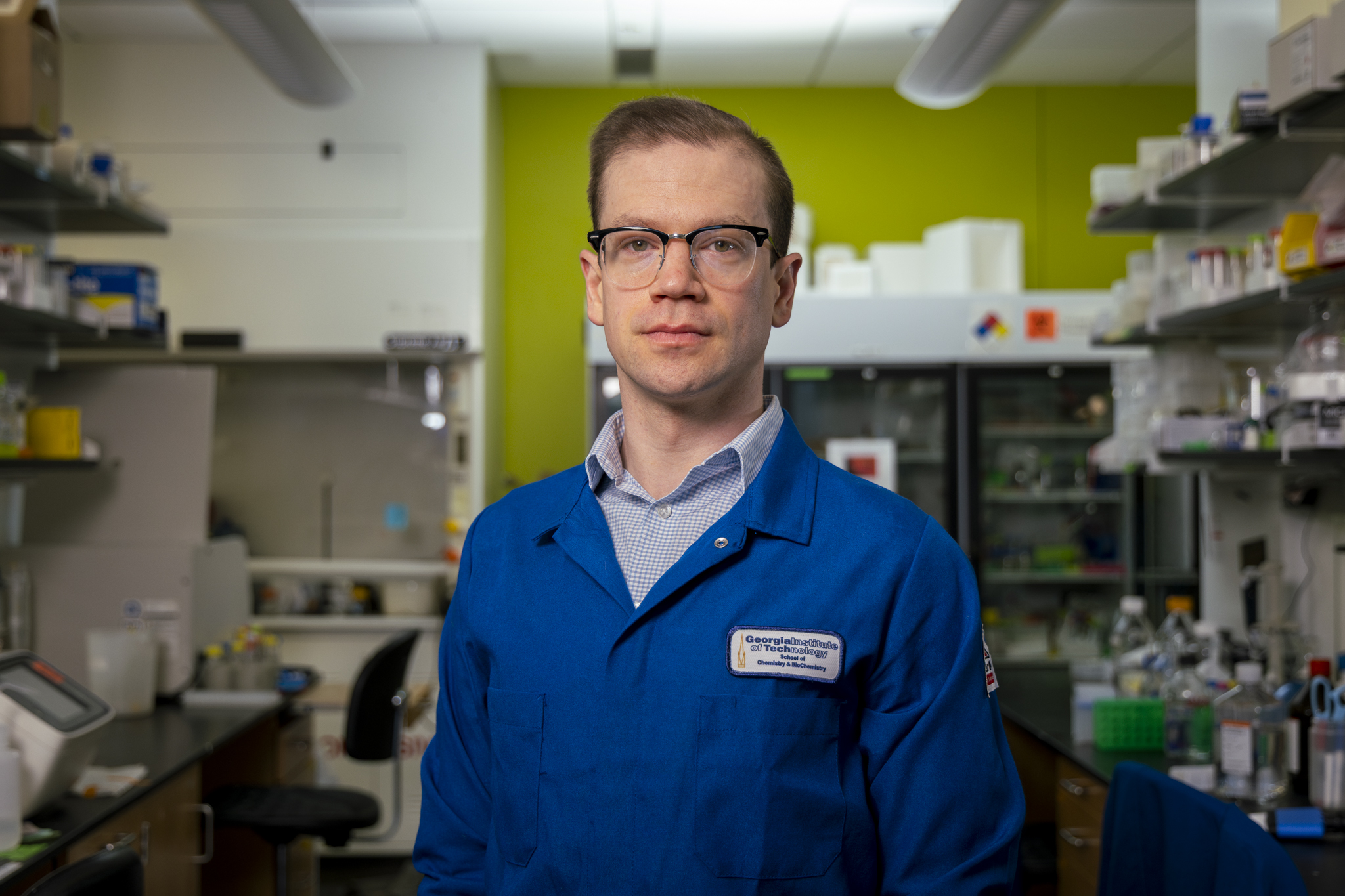
Georgia Tech researchers are investigating how ovarian cancer connects with the nervous system, and whether those interactions could reveal new approaches to treatment.
One of the biggest breakthroughs in modern cancer treatment doesn’t attack cancer directly. Instead, immunotherapy harnesses the body’s immune system to recognize and destroy cancer cells.
Now, Nick Housley is exploring whether another bodily system could be recruited in the fight against cancer: the nervous system.
“From first principles, the nervous system is involved in every aspect of normal development and bodily maintenance,” says Housley, an assistant professor in the School of Biological Sciences and faculty director of Innovation for the Institute for Neuroscience, Neurotechnology, and Society. “When these normal processes go awry, the nervous system is not just a bystander. It is actively driving changes and/or responding to disease.”
With a new five-year, $3 million Stephen I. Katz Award from the National Institutes of Health, Housley aims to uncover how cancer interacts with the body’s neural circuitry and whether those connections could ultimately reveal new ways to fight the disease.
The idea that cancer and the nervous system interact isn’t entirely new. Scientists have known for more than a century that many solid tumors are connected to nerves. More recently, studies of brain cancer have revealed that tumors can form circuits with neurons that affect cancer growth, invasion, and resistance to treatment. But exactly how cancers elsewhere in the body connect with and potentially exploit the nervous system is largely a mystery.
Housley is starting with the ovary, an organ especially reliant on cues from the nervous system for normal function. Ovarian cancer is also one of the leading causes of cancer death among women, making the need for new approaches especially urgent.
“Ovarian cancer is tricky because it disproportionately lacks clear early symptoms,” says Housley. Without reliable symptoms or an effective early screening method, the disease is often not detected until later stages, when it is more difficult to treat. “We are very interested in understanding how the tumor innervates and integrates into the host nervous system to modulate activity patterns and remain hidden.”
Yet even the baseline for understanding those connections is missing. Scientists don’t yet have a complete map of the neural circuitry of a healthy ovary, much less an understanding of how that circuitry changes when cancer develops.
That kind of knowledge gap is precisely what the National Institutes of Health’s Stephen I. Katz Award is designed to address. It empowers early-career scientists like Housley to make bold research pivots into new scientific fields without requiring preliminary data.
With the Katz Award, Housley will start by creating the missing neural map of the ovarian system, comparing neural connections in healthy and cancerous ovaries and tracing them from local networks to the spinal cord and brain.
“We’re trying to figure out who’s connected to whom and whether those structural connections are functional,” he said.
From there, his team will examine how ovarian cancer cells and neurons communicate and how those interactions affect both cell types. Finally, they will manipulate specific populations of neurons to test how neural activity affects tumor development, progression, and response to cancer treatments.
“Where we are right now with cancer neuroscience is very similar to where immunotherapy was several decades ago,” Housley said. “Our blue-sky goal is to develop enough foundational knowledge about how the nervous system interfaces with ovarian cancer that we can exploit it — suppressing pro-tumoral signals and enhancing tumor suppressors to improve patient outcomes.”