
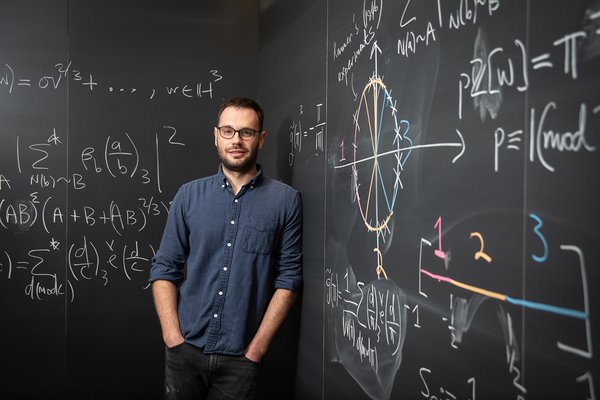
OpenAI’s proof draws on techniques developed by mathematicians, including Georgia Tech’s Alexander Dunn.
In early October, OpenAI published a proof of the quasi-Riemann hypothesis, a result that could mark an important step toward understanding the distribution of prime numbers. Prime numbers are fundamental to mathematics; their distribution is central to number theory with implications for modern technology, including encryption.
The proof uses mathematical techniques developed by Alexander Dunn, the Richard A. Duke Assistant Professor in the School of Mathematics, and Maksym Radziwiłł, professor of mathematics at New York University. Dunn and Radziwiłł developed the tools while working to resolve a different problem in number theory.
“Seeing our tools used in OpenAI’s proof was unexpected,” says Dunn.
He believes OpenAI’s so-called “11/12 manuscript” is correct and is working alongside other mathematicians to review the proof and its sources.
“We are seeking to understand what makes the model’s arguments work and how far its method can go,” says Dunn. “But it is too early to say whether it will help resolve the full Riemann hypothesis.”
Proposed by 19th-century mathematician Bernhard Riemann, the full Riemann hypothesis has remained unsolved for more than 160 years, and is one of the most prominent problems in theoretical mathematics, according to Michael Wolf, chair of the School of Mathematics.
Even if OpenAI’s method does not resolve the full hypothesis, the 11/12 manuscript may still have broader implications for mathematics.
“The present work by OpenAI, while not the whole problem, is both remarkable progress and deeply impactful; the entire mathematical community is buzzing about this development,” says Wolf. “Years ago, Alex decided to chart a novel course in his research — a brave move for a young researcher. It is so gratifying to see his boldness yield such strong results. We are thrilled that he is part of our Georgia Tech mathematical community.”