
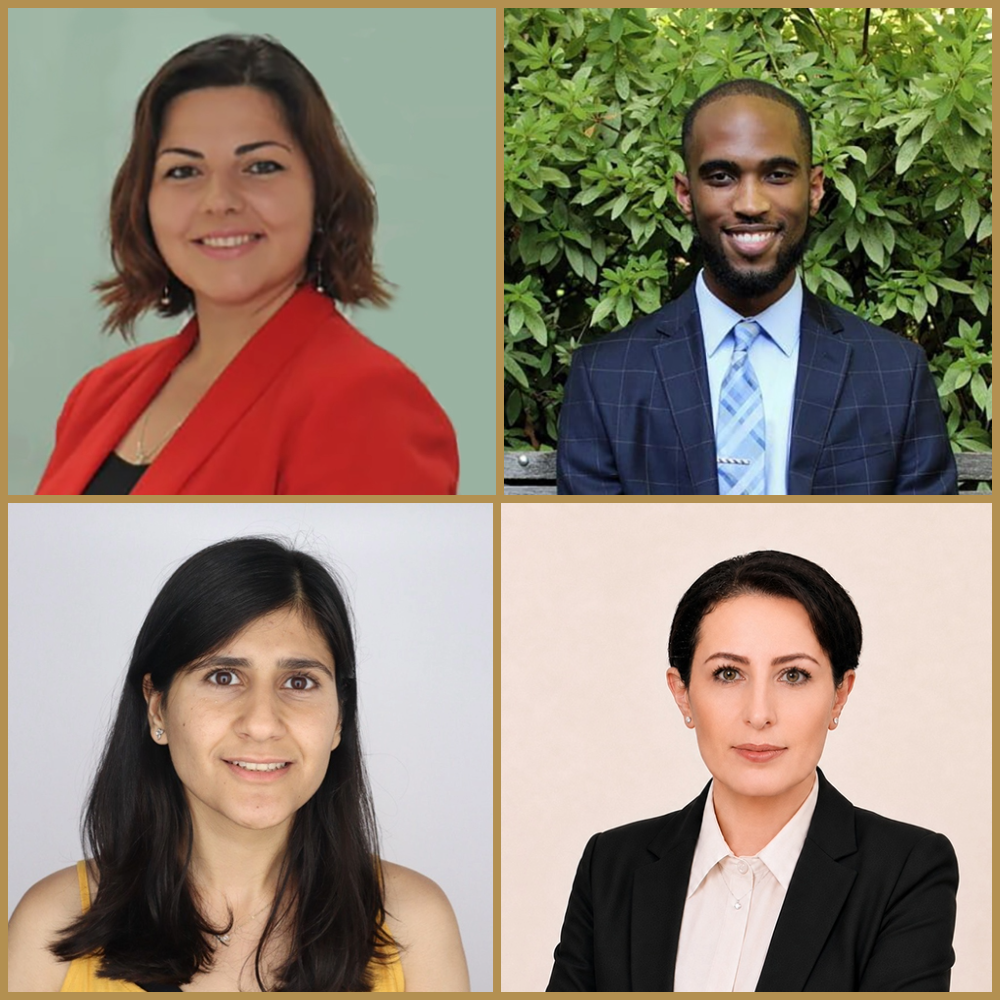
From Top Left (Clockwise): Ana Mazmishvili, Ryan Anthony, Samin Alipour, Faeze Fahimi Aghda
Four Georgia Tech doctoral students spent the summer working on their dissertation research through the Energy Policy and Innovation Center's (EPIcenter) Summer Research Program. The competitive program provides a full summer-semester stipend, along with mentorship and professional development opportunities, to support emerging energy scholars.
"One of the goals of the program is to give students the time and support needed to make meaningful progress on their dissertation research while helping them understand the broader policy, economic, and societal implications of their work," said Laura Taylor, director of EPIcenter.
The stipends enable participants to focus exclusively on clearly defined research goals. The program also supports peer discussions, communication training, and interdisciplinary learning opportunities designed to strengthen both their research and professional development.
This year's cohort explored topics ranging from electricity markets and air pollution to critical mineral supply chains and grid modernization, highlighting the breadth of energy-related research taking place across Georgia Tech.
Four Georgia Tech doctoral students spent the summer working on their dissertation research through the Energy Policy and Innovation Center's (EPIcenter) Summer Research Program. The competitive program provides a full summer-semester stipend, along with mentorship and professional development opportunities, to support emerging energy scholars.
"One of the goals of the program is to give students the time and support needed to make meaningful progress on their dissertation research while helping them understand the broader policy, economic, and societal implications of their work," said Laura Taylor, director of EPIcenter.
The stipends enable participants to focus exclusively on clearly defined research goals. The program also supports peer discussions, communication training, and interdisciplinary learning opportunities designed to strengthen both their research and professional development.
This year's cohort explored topics ranging from electricity markets and air pollution to critical mineral supply chains and grid modernization, highlighting the breadth of energy-related research taking place across Georgia Tech.
Exploring Complex Energy Challenges
Ana Mazmishvili, who studies environmental and energy economics, used the summer to examine how climate policies affect communities across state lines.
"My research measures who is actually exposed to pollution from power plants when some states adopt climate regulations to cut emissions while neighboring regions do not," Mazmishvili said. "Because air doesn't stop at state borders, the key question is what happens once the pollution is emitted, and who ends up breathing it."
Her work focuses on the Regional Greenhouse Gas Initiative (RGGI), a cap-and-trade program in the Northeast, and investigates whether the benefits and burdens of emissions reductions are distributed equitably between regulated and neighboring states.
Mazmishvili said the program provided valuable time to focus on her job-market paper, a central component of her dissertation.
"The regular meetings with the program director and other fellows create useful accountability checkpoints and let me hear perspectives from people in very different fields," she said. "We're also learning how to make academic research understandable to a general audience, a skill I expect to use well past this summer."
Industrial and systems engineering doctoral student Faeze Fahimi Aghda spent the summer developing an optimization model for the U.S. gallium supply chain, a critical component of many advanced technologies.
Her research uses mathematical modeling to examine where and when domestic gallium processing facilities should be established under the threat of supply disruptions.
"Working on my research through EPIcenter has taught me to look at my problem from a policy point of view rather than focusing only on the math," Fahimi Aghda said. "The feedback within the meetings helped me improve my model."
Ryan Anthony, in the Jimmy and Rosalynn Carter School of Public Policy, explored how one of the largest oil shocks in U.S. history affected electricity customers and whether utility ownership influenced the impact on consumers.
"So far, my research suggests that it mattered a lot,” Anthony said. “Municipal utilities held rates down and absorbed many of the costs, while private, investor-owned utilities passed more costs through to their customers."
Anthony said the program provided critical support for the archival research required for the project.
"My project depends on data that only exists in old government reports, and that kind of archival work is difficult to fund," he said. "EPIcenter gave me the time and space to do it properly."
Connecting Research to Real-World Impact
For Samin Alipour, the summer provided an opportunity to explore how electric grids can adapt to growing numbers of distributed energy resources.
"Most electric distribution systems were built like one-way roads, carrying power from a substation to homes and businesses," Alipour said. "Rooftop solar, batteries, and electric vehicles are turning those roads into two-way systems."
Her research examines how these emerging technologies can be coordinated to increase grid flexibility and clean energy adoption while maintaining safety and reliability and ensuring that costs and benefits are distributed fairly.
With support from EPIcenter, Alipour focused on the economic and policy dimensions of those challenges. "I did not want my research to remain only a technical model," she said. "The program has helped me connect the technical results of my dissertation to economic value, reliability, equity and compensation policy."
One study developed during the summer was accepted for presentation at a specialized power systems conference, an achievement Alipour credits in part to the opportunity to focus on the broader implications of her work.
Building the Next Generation of Energy Scholars
Beyond advancing individual research projects, the Summer Research Program encourages students to engage with colleagues from different disciplines and develop skills for communicating complex ideas to broader audiences.
“Through regular cohort meetings, participants build a community of accountability, discuss research challenges, explore interdisciplinary energy topics, and develop communication skills,” said Gil Gonzalez, program support coordinator for EPIcenter. “Students also write a research-focused blog post for EPIcenter and present their work at the program's fall workshop, which allows them to share their research with the broader Georgia Tech energy community.”
As EPIcenter continues to support interdisciplinary energy scholarship at Georgia Tech, the Summer Research Program equips future leaders with the tools to address complex energy challenges through technological innovation, informed policy, and economic analysis.