
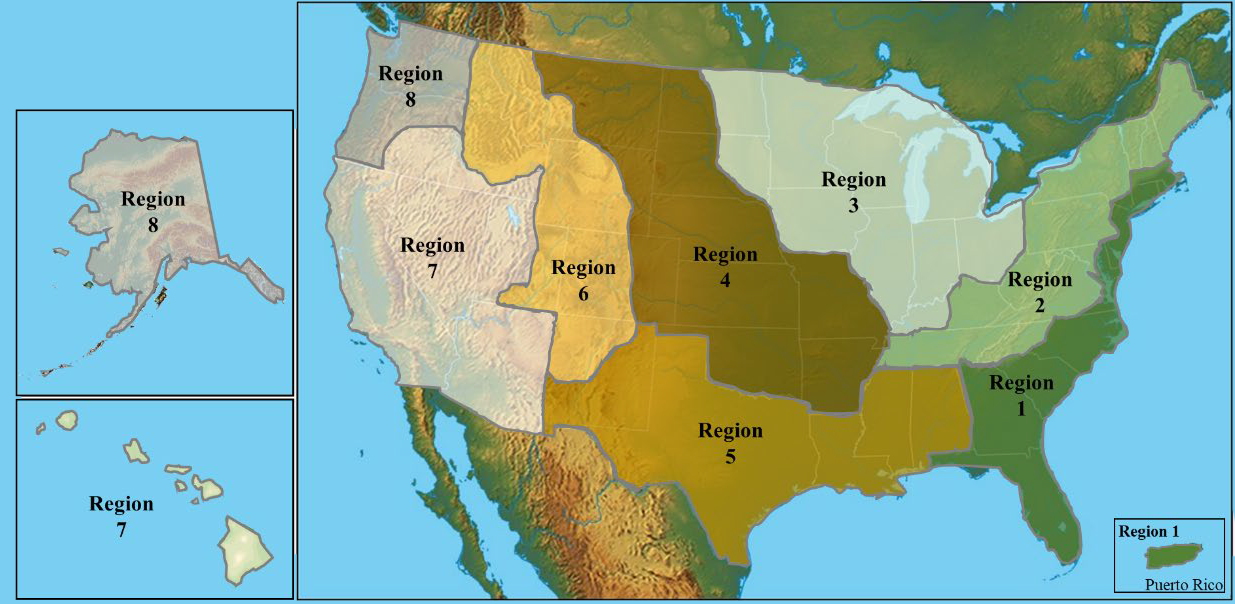
United States map showing the eight regions of the CORE-CM Initiative. Courtesy: Department of Energy Core-CM Initiative
Selected by DOE’s Office of Critical Minerals and Energy Innovation, Georgia Tech will lead the Critical Minerals in the Atlantic Seaboard Plain (CM-MAP) project. The regional effort builds on DOE’s Carbon Ore, Rare Earth, and Critical Minerals (CORE-CM) initiative and will examine potential resources across the Atlantic coastal plain.
A new Department of Energy award will help Georgia Tech lead a regional effort to identify, recover, and reuse materials essential to energy, manufacturing, and national security.
Critical minerals power the technologies that define modern life, from batteries and semiconductors to advanced manufacturing systems and defense applications. They are also essential to the nation’s energy future, manufacturing competitiveness, and national security.
Through a major investment from the U.S. Department of Energy (DOE), Georgia Tech is helping accelerate the development of domestic critical minerals from unconventional and secondary resources. The $7.5 million award positions the Institute to advance supply chain solutions that span resource discovery, processing, recycling, and circular materials management.
Selected by DOE’s Office of Critical Minerals and Energy Innovation, Georgia Tech will lead the Critical Minerals in the Atlantic Seaboard Plain (CM-MAP) project. The regional effort builds on DOE’s Carbon Ore, Rare Earth, and Critical Minerals (CORE-CM) initiative and will examine potential resources across the Atlantic coastal plain.
The CM-MAP project will focus on sedimentary deposits, including kaolin, bauxite, heavy mineral sands, and phosphates, as well as legacy mining residues, coal combustion byproducts, and other unconventional and secondary resources that could support future recycling and circular economy opportunities.
Drawing on existing infrastructure, regional assets, industry bases, and scientific expertise, CM-MAP will establish a regional innovation ecosystem that supports domestic critical mineral production, recycling, and advanced manufacturing, while fostering new economic opportunities throughout the Southeast.
“This is a powerful example of how Georgia Tech brings together leading research capabilities and partnerships from industry, government, nonprofits, and national labs to address complex national challenges,” said Tim Lieuwen, executive vice president for Research. “By identifying and domestically sourcing critical minerals, we are helping secure essential supply chains, while enabling the next generation of energy and materials technologies.”
The DOE award builds on a growing network of research, industry, regional, and international partnerships led by Georgia Tech to translate scientific discovery into real-world supply chain solutions, including:
- Research leadership — Founded in 2024, Georgia Tech’s Center for Critical Mineral Solutions serves as a hub for interdisciplinary research and technology development across the Institute.
- Regional partnerships —Through the Georgia Partnership for Essential Materials, a flagship regional collaboration platform, Georgia Tech, the University of Georgia, Georgia State University, and the Georgia Mining Association convene stakeholders from across the critical minerals sector. The partnership brings together industry, nonprofit organizations, regional economic development agencies, national labs, universities, and technical colleges to connect, collaborate, and stay engaged in the latest developments.
- International engagement — A U.K.-U.S. working group extends partnerships across the Southeastern United States and Southwest United Kingdom, connecting researchers, industry leaders, and government agencies working to strengthen global supply chains.
- Georgia Critical Mineral Supply Chain Manufacturing Demonstration Center — Supported through congressional funding, the center is developing capabilities and regional supply chain demonstrations that connect resource development, materials processing, recycling, and advanced manufacturing.
As part of CM-MAP, researchers will analyze materials collected from natural deposits and industrial sites throughout the Southeast to identify their critical mineral content. The resulting large datasets will be combined with artificial intelligence and machine learning approaches to better understand and predict where resources exist, optimize extraction pathways, and inform future recovery and recycling strategies.
“This project brings together a highly collaborative team from Georgia Tech, national labs, industry partners, and research institutions across the region,” said Yuanzhi Tang, the principal investigator and Georgia Power Professor in the School of Earth and Atmospheric Sciences, with a courtesy appointment in the School of Civil and Environmental Engineering.
Tang is also the founding director of the Center for Critical Mineral Solutions and executive director of the Strategic Energy Institute.
“Through this award, we are working to build secure and resilient critical materials supply chains, from resource discovery and characterization to processing, recovery, recycling, and advanced manufacturing, while also developing the skilled workforce needed to support these emerging industries,” Tang said. “Our vision is to create a regional innovation ecosystem that embraces both unconventional resources and circular economy approaches to maximize the value of materials already in use.”
Learn more about critical materials research and workforce development efforts at Georgia Tech by visiting the Center for Critical Mineral Solutions webpage.