

Approved by the Board of Regents in 2017, the B.S. in Neuroscience program is one of Georgia Tech’s fastest-growing majors.

Both Anthony Diaz and Melissa Nord have EAS degrees, but they pursued divergent professional trajectories — one crafting on-air weather forecasts and the other forecasting strategic shifts in the corporate world.

The dashboards highlight significant achievements in joint research, funding, and innovation, demonstrating each partnership’s commitment to addressing critical global challenges.
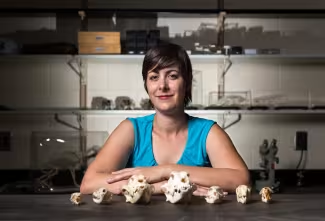
Jenny McGuire has been named a Teasley Professor, advancing Georgia Tech’s leadership in biodiversity research and climate resilience.

Snigdaa Sethuram (Ph.D. PHYS 2025) recently joined the Argonne Leadership Computing Facility as a Margaret Butler Fellow in Computational Science.

Researchers at Georgia Tech have developed an algorithm that helps AI models develop internal organization just like the human brain — boosting efficiency by 20 percent.

The award will support Kostka’s research on the role of marine plant microbiomes in coastal climate resilience in collaboration with Germany’s Max Planck Institute.

Ocean waters are getting greener at the poles and bluer toward the equator, according to an analysis of satellite data published in Science on June 19.

Insights could not only pave the way for new treatment strategies for genetic disorders, cancer and neurodegenerative diseases, but also enhance gene-editing technologies.

Georgia Tech researchers are innovating ways to study air quality — beginning with prehistoric insights and zooming all the way to satellites in our orbit.