

Yuanzhi Tang, executive director of the Strategic Energy Institute (SEI) and Georgia Power Professor in the School of Earth and Atmospheric Sciences, has been named an American Chemical Society (ACS) Fellow.
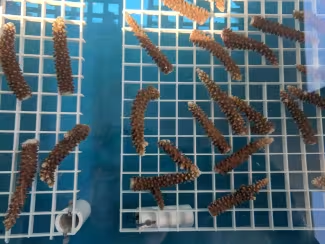
Georgia Tech researchers found that predatory bacteria can halt the spread of a destructive coral disease by hunting and consuming pathogens responsible for the infection.
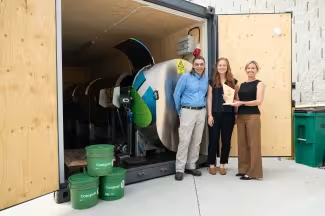
Georgia Tech’s in-vessel composting program earns national recognition.
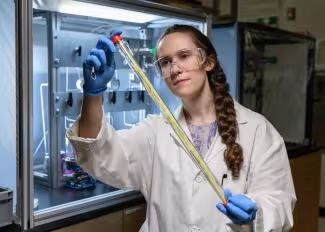
Institute researchers will lead two projects and contribute to several others as part of the Department of Energy’s $5 billion initiative.
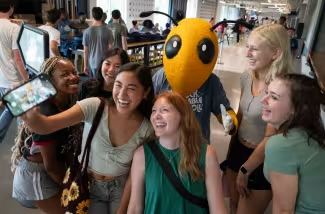
A historic $415 million fundraising year fuels scholarships, academic excellence, and major capital projects across the Institute.

For the value it offers students, the Institute earned a five-star rating from the publication.
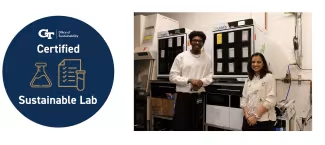
Campus labs have a new pathway to strengthen sustainable operations through a campus comprehensive certification program.

Meghna Iyer (Biology 2026) came to Georgia Tech trying to understand her mother’s illness. What she discovered is changing how scientists connect three neurodegenerative diseases.

Parker H. Petit’s commitment will launch a research hub focused on using artificial intelligence to model diseases, identify treatment paths, and move discoveries closer to patient care.
A Georgia Tech student transformed her search to understand her mother's ALS into AI-driven research that could reshape how scientists study neurodegenerative diseases.