

Georgia Tech’s Climate Action Plan outlines mitigation and adaptation strategies for reaching net-zero emissions on campus by 2050 and contributing to global solutions through education and research.

Through detailed auditory descriptions and immersive virtual environments, the Sonification Lab facilitates accessibility to the wonders of the universe for all, regardless of visual ability.

Sparked by a professor’s interest, 55 students from the School of Physics will travel to Illinois to enter the path of totality for the April 8 total solar eclipse.

April is Earth Month with a full calendar of events open to the campus community.
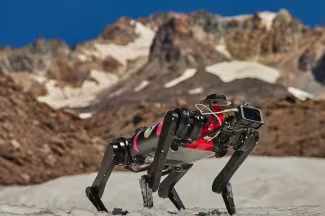
Researchers at Georgia Tech have teamed up with NASA and five peer institutions to teach dog-like robots to navigate craters of the Moon and other challenging planetary surfaces.

Wise, a professor in the School of Physics and director of the Center for Relativistic Astrophysics, spoke to how the James Webb Space Telescope has impacted astrophysics and our understanding of the formation of black holes.
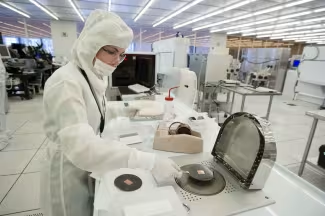
Georgia Tech launched an initiative to recognize and develop its research faculty, who comprise 60% of the nearly 4,400 total faculty currently employed at the Institute.

While outside of the path of totality, the Georgia Tech community can still take part in the historic April total solar eclipse.

Du's project has the potential to make important contributions to the field of quantum materials, and in developing next-generation, transformative information technologies.

Latest AI Magazine highlights work of NSF and USDA-NIFA-funded AI Research Institutes, including AI-ALOE, AI4OPT, and AI-CARING, focusing on their contributions to AI for societal good and future impact.