

Latest News




Experts in the News
Georgia Tech researcher warns of heat stroke as temperatures rise
Dangerously high heat levels forced at least one metro Atlanta school district to pull students inside Monday as heat index values head toward triple digits this week.
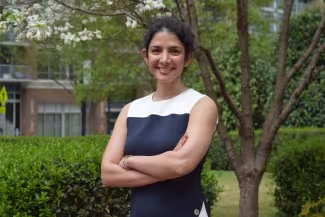
Georgia Tech biology adjunct professor Mike Sawka explained that extreme heat creates severe cardiovascular strain during exercise. "The main problem with heat stress is it puts stress on the cardiovascular system," Sawka said. "The blood flow that would normally go to the muscles has to be shared by the skin. So as you exercise, you're cheating the blood flow from the heart called your cardiac output".
Sawka noted that extended exertion in hot weather puts the human body into overdrive, triggering a progression of severe health risks. "That can lead to either heat exhaustion, heat injury, or heat stroke, which is a continuum of serious heat illnesses, with heat stroke being the most severe," Sawka said.
Fox 5 Atlanta
Georgia Tech students complete first simulated Mars mission
After 10 days in isolation, a group of Georgia Tech students will be returning from Arkansas having completed their first simulated Mars mission. Southeast Analog is a program run by students at Georgia Tech interested in spaceflight.
The SEA-1 Thalassa mission included six "astronauts" on a simulated Mars habitat in Arkansas and 30 crew in mission control on campus. Students in the Southeast Analog program worked in three shifts around the clock to do astronaut training, spaceflight operations, and research.
Similar news stories: Atlanta News First, Fox 5 Atlanta, Hoodline
GPB
Sargassum, the smelly nemesis of beach vacations, has become a self‑sustaining disaster that will keep coming back
In an article published by The Conversation, Professor Joseph Montoya, Postdoctoral Fellow Xing Zhou, and their collaborator discuss sargassum blooms and their impact on the Caribbean and Gulf coasts and the coasts of the tropical Atlantic. According to their research, the vast mats of smelly, brown seaweed affecting these areas may have entered a "self-sustaining cycle, effectively feeding their own expansion."
The Conversation