

For Georgia Tech physicists, this year’s Nobel Prize in Physics recognizes decades of work that helped establish neutrino astronomy as a new way to understand the universe.
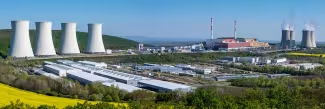
A three-part webinar series hosted by Georgia Tech's Energy Policy and Innovation Center provided an accessible introduction to the science, economics, policy, and geopolitics shaping the future of nuclear energy.

New research from Georgia Tech shows that a person's environment and life circumstances can amplify or reduce the health risks encoded in our DNA — leading to an array of health outcomes.
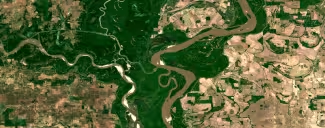
Scientists used the Mississippi River Basin’s 100-year record to show that liming, long considered a source of carbon emissions, may actually remove carbon overall.

David Ballantyne and Mariel Borowitz join SRI's leadership team to strengthen interdisciplinary research, expand strategic partnerships, and advance Georgia Tech's growing space enterprise.

Regents’ Professor Facundo M. Fernández will serve a two-year term on the board of an international society dedicated to advancing the study of metabolites, small molecules found in living systems.
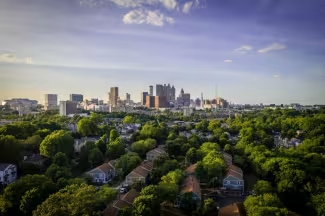
A new study by EPIcenter affiliate Marilyn A. Brown and coauthor Majid Ahmadi examines how racial segregation affects what households pay for basic utilities.

Congratulations to the 2026 Distinguished Alumni Award winners.

The CHORUS research project will combine advanced flood modeling, artificial intelligence, and community partnerships to help coastal residents in Georgia and New York evaluate flooding solutions and shape resilience planning.

The Georgia Tech Career Center offers a few tips for students attending the fair. Most importantly — mark your calendar for Sept. 14 – 15 from 10 a.m. to 4 p.m. at the Campus Recreation Center.